Friday, September 15, 2006

Why Overpopulation is Not a Problem

Ever since the 1960s, the issue of overpopulation has been a hotly debated topic. Overpopulation, however, might not be as big of a problem as it seemed at the time.

Accelerating Future
has written another blog post that deals with this issue. As the population of the US surpasses 300 million, many are worried that the US will not be able to hold many more people. This is one of the arguments being used against immigration. Never mind that China, which is of similar area to the US, holds 4 times as many people. But how uncrowded is the US? It is often said that all of the world's people could fit on a very small island. But then again, the issue of overpopulation is not about real population density, but rather whether there are enough resources to go around. Is there enough farming space to feed the world? Here's what Michael Anissimov had to say:
So it turns out that if 5% of the United States were converted into urban area with a population density of 6,000/km², and 45% were converted into suburban area with a population density of 2,000/km², with the remaining 50% left for rural area, parks, and farms, there would be enough room for 3 billion in the urban areas, and 9 billion in the suburban areas, for a total population of 12 billion. This is in the US alone. This scheme could be extended to the other countries and continents for a total population of around 100 billion. Everything between the Arctic and Antarctic circles are potential targets for colonization. This is about 130,000,000 km² of land area (the circumpolar regions have about 20,000,000 km² of land).
12 billion people in the US? That's a lot of people. To do this, the five major obstables to this are
  • colonizing the deserts
  • colonizing the highlands
  • providing energy
  • providing food
  • disposal of waste
In the blog entry, he sets forth many solutions to these problems, so be sure to read it. During the 1970s, it was believed that the Earth had a carrying capacity of about 10 billion people. With the advances in science and technology at this time, we now know that the number could be much, much higher.

Accelerating Future: Better Ways to Get To Space

The blog Accelerating Future has an entry on the various methods that are being studied to provide routine travel from the Earth's surface to orbit. Among the topics include rocket planes, space elevators, space ports, orbital airships, and more.

Sunday, September 10, 2006

Life , Liberty, the Pursuit of Happiness, Equality, and Fraternity

"We have it in our power to begin the world over again." -- Thomas Paine in Common Sense, 1776

Many people wonder why we are interested in the settlement of space and the oceans. To many, it is a very odd goal to focus on, especially when there are still problems on Earth that need to be solved (this objection will be addressed in a future blog entry). To most who are space and ocean enthusiasts, the answer is self-evident. All of us enthusiasts have our own vision of space/ocean settlement, and they seem to emanate from some inner desire (see Space Settlement: The Journey Inward). But for those of us who do not have this desire, this bears expanation. Of course, there is no one explanation. There are many reasons we can (and often do) use to justify it. In this blog entry, I will use the "City Upon a Shining Hill" argument.

In the book Mining The Sky John S. Lewis writes this:
Who will go into space [and the oceans]? It's not always easy to leave, especially for those with the greatest need to leave. The worst tyrannies want stability at any price...they violently oppose emigration because it fosters the notion that there is a way out; it raises hopes...Space [and the oceans] will at first be largely a haven for refugees. The refugee state is usually a melting pot. New Amsterdam in the late 1600s was an amalgam of Huguenots from France, Walloons from the Low Countries, English dissenters, Puritans, and Sephardic Jews from Iberia. ..they were all there because they were escapees from Roman Catholic or Anglican persecution. Their common desire was to have religious freedom...It was this search for freedom from religious, political, and ethnic persecution that will send the first [settlers] forth into space [and the oceans]. Thereafter, anyone who wants to go will be able to do so.
During the 1930s and 1940s, the Jews of Europe desperately sought to escape persecution and eventually mass slaughter. Citizens of the Soviet Union have routinely tried to defect to Western Europe or the United States. Today, the United States and Western Europe attract many of these immigrants from around the world. A lot them have experienced deplorable conditions. They have come from extreme poverty and persecution. But will the US and Europe always be good places to emigrate to? There is growing anti-immigrant and nativist sentiment in these regions. It is not hard to imagine a world in 2012 in which America and Europe shut their doors to immigrants desperately trying to escape genocide.

Things could very well come to a point in the currently developed nations in which people will want (or need) to leave. Perhaps, freedom in these areas of the world could wane. While many think that this can't happen, keep in mind that there is a rising demand for the persecution of Muslims in Europe and in the US. When Bush won the presidential election of 2004 (one that a lot of people believe was stolen), many liberals and leftists seriously contemplated (and few actually did resort to) moving to Canada. Even though the 1990s seemed like good times compared to today, there were many people who thought that the US government was moving in the wrong direction. Many libertarians certainly felt that way, and many do now. The majority of the people (citizens of all political stripes) in the US today are dissatisfied with the current direction of the nation.

When people are dissatisfied with the way things are going, they come up with new ideas. Protestant Christianity arose from centuries of corruption in the Roman Catholic Church. The US was born because of mis-government on the part of colonial and British leaders. The abolitionist movement was born because of the evils of slavery in an era of liberty. As misguided as the authoritarian communist movement was, the movement was born because of exploitative and abusive labor practices. Today, there are many people who have differing ideas on rebuilding society. There is always a better way that things can be done, it seems. As Lewis states:
Subversives, idealists, inventors, artists, scientists, and mystics alike...have a nasty way of asking questions such as, "Why do we have to do this? Why not that?"
There are many who believe that they still can perfect socialism. Some believe in laissez-faire capitalism. Many want to try a direct democracy. Still many others dream of building the first "open source civilization". In an era in which all land of currently under someone else's control, trying to build an experiment for your new idea can be very difficult, and often results in bloodshed. People with new and/or divergent ideas will be persecuted. Many people disagree with Margaret Thatcher when she stated that "There Is No Alternative" to the current social system. And there are a lot of people who are set to prove her wrong.

Americans commonly believe that the issue of secession was settled -- once and for all -- by the US Civil War. But today, the the demand for secession and the demand for moving elsewhere is greater than most people realize. On the Internet, you can find a lot of groups with the aims of secession. This Wikipedia entry has a partial listing of various secessionist movements, and also movements for the creation of new nations around the world. When the opportunity to seastead or settle space finally arrives, there will be many, many more people who will want to move, and also a lot more reasons. And many of these people will form new social experiments. They will want to push the limits of liberty, equality, community, spirituality, freedom, democracy, lifestyle, social organization, science, art, expression, thought, and humanity. Those social experiments that fail will be thrown to the dustbin (or the recycle bin) of history, while those that are successful will be copied, and will inspire even newer types of societies.

Wednesday, August 30, 2006

Why Friedman Is Wrong

Louis D. Friedman recently wrote a blog entry for the Planetary Society.
"I don't blog," I asserted about six months ago. But then again, I also recall saying (sometime in the last century) "I don't do Windows -- DOS is good enough for me." Well, times change; and here I am. This is an experiment. We'll have to see what the reaction (mine and yours) is.
Perhaps, this is the problem right here. There seems to be an unwillingness to change and to progress. Judging from this blog entry, Friedman strikes me as a person who likes things to remain constant, to remain the same until something forces him to advance. At what point did he decide to start "doing Windows"? When Microsoft stopped supporting DOS? And the threat of cutting his "science and exploration" caused him to make another major leap into the future, which is the start of using blogs. For being in a field that is supposed to look towards our future, he seems way too antagonistic to change and to progress. In his blog entry, he adds:
First the U.S. Administration presented a budget to Congress severely cutting back space science research and missions, including great exploration missions to Mars, Europa, and searching for terrestrial planets around other stars. Then...they announce that understanding the Earth is not a goal of NASA's anymore -- despite the fact that understanding the Earth has been one of the principal products of space exploration.
I remember reading somewhere that we should turn the understanding of the Earth to NOAA. Perhaps, the NOAA can do the space missions for the scientific study of our planet, while we free NASA to explore deeper into space. He continues:
The problem is not simply about budget priorities...It is much deeper; it is about the heart and soul of exploration, which is the fundamental goal of NASA. NASA has separated science from exploration, bureaucratically and in their development of missions. They dismiss the great robotic missions: Voyager, Galileo, Cassini, Mars Exploration Rover, New Horizons (past) and Europa Orbiter, Mars Sample Return, Dawn, Terrestrial Planet Finder (future) as only science. Whereas the Vision for Space Exploration strongly supported these robotic missions and the search for extraterrestrial life, the new NASA exploration program cut out half the research connected with the latter subject and all those future missions I just mentioned.

Why would they do this? If the Administration can't supply the funds for the Vision for Space Exploration goals, wouldn't just delaying them make more sense than cannibalizing the part of NASA that is working and has provided such valuable and exciting results to the world, and which was supposed to guide humans into the solar system?

I think I am beginning to understand why. [The] President's science advisor, Dr. John Marburger, declared, "…we want to incorporate the Solar System in our [the U.S.] economic sphere…" and then went on say "The fundamental goal of this vision is to advance U.S. scientific, security, and economic interests through a robust space exploration program.…It subordinates space exploration to the primary goals of scientific, security and economic interests." Whoa -- what happened to exploration? What are the American economic and security interests in human exploration of the Moon and Mars? What happened to "we came in peace for all mankind?"

Marburger has gone further. In testimony to Congress he asserted, "The greatest value of the Moon lies neither in science nor in exploration, but in its material ... The production of oxygen in particular, the major component (by mass) of chemical rocket fuel, is potentially an important Lunar industry." This is ludicrous -- we could probably not devise a more expensive way to make rocket fuel than by producing it on the Moon -- especially with oxygen which we do not know how to extract, or at what cost.
This seems like a sound argument, but it is a dead end. I agree with Friedman on the importance and significance of the great exploratory mission of Galileo, Cassini, Voyager, Pathfinder, and other robot exploratory missions. But his argument is a total dead end. Where have we been in space since the Apollo Era? Since 1972, no human has left Low Earth Orbit. And again, we have had great robotic exploratory missions since Apollo, but if Friedman gets his way, that's all we will be doing for the next 30 or so years. Humans will fail to leave Low Earth Orbit for the next 30 years. The Space Shuttles will crumble while we use rockets based upon 20th century technology to launch our exploratory missions. Is this a future worth having? Not if it could be much better.

The importance of space industry and manufacturing for mandkind is beyond the scope of this blog entry. In fact, that will be the subject of other blog entries. This blog entry is focused on Friedman's goals of exploration and science. I believe that if Friedman is really concerned about science and exploration, then he should back Griffin's moves. Consider this: What has to come before industry and economic development? You guessed it: science and exploration. The economic development of colonial America could not have happen if the Americas was not explored first. The same is true for space.

When we go to the Moon to mine it for its oxygen, it will be based upon plenty of exploration and science. So let's go 20 years into the future, when there is a base on the Moon that is mining it for its oxygen, and for materials to build solar power to export to Earth. It will then be orders of magnitude easier to build a base for science and further exploration of the Moon than otherwise. The Lunar factories could build the tools for Lunar science and exploration much more cheaply than it would cost to launch it from Earth. The Lunar factories could fabricate the Lunar rovers. Controlling Lunar rovers using telepresence would be much better on the Moon than from Earth because there would be no delay in transmission.

And you want to search for new bodies in the Solar System, around other stars, and for extraterrestrial life? Why not build a giant telescope on the dark side of the Moon, which has been a dream for space enthusiasts? Without the development of space, such a project would be next to impossible. But with space development, the Lunar factories could build the parts to it, and then our robots or humans could build it. This telescope will make mincemeat out of Hubble! And finding a way to extract oxygen from Lunar rocks is a very worthy scientific goal.

And what of Mars and the Asteroids? If we have the sufficient infrastructure then we could do this MUCH more cheaply than otherwise. We could build spacecraft to these bodies without having to launch them out of Earth's massive gravity well. This means that we can have far better missions to these bodies than would be possible otherwise. And we would be in a much better position to send humans to these bodies, and to even build bases there, which would further not only the economic development of these bodies. They would further the exploration and the scientific study of these bodies.

As for cutting many scientific missions, by the time we build our space economic infrastructure, these missions will be hopelessly obsolete. The space infrastructure we build will promote the development of exploratory missions that are MUCH better than would be possible without that economic development. The craft we send can be much bigger. We won't have to worry about Earth's gravity well. Just build the craft in orbit using mined Lunar material. Even launching from the Moon would be much cheaper, and allow for much larger missions.

I applaud Griffin for what he is doing. Friedman is hopelessly near-sighted. And by doing so, he is ultimately causing much harm to his own dreams and goals of more exploration and science. It is time that we think in the far term. We can have space development AND we can have science and exploration that is far beyond what Friedman seems to be able to imagine.

And another thing. Science and exporation is good. But what about building space industries that can heal the Earth? What about building Solar Power Satellites that can liberate us from fossil fuels? What about the settlement of space? What about people living in orbit, on the Moon, Mars, asteroids, and other Solar System bodies? Are these not worthy goals for NASA?

Monday, August 21, 2006

Funny UserFriendly Comic

If you guys have not heard of this comic strip, you need to check it out. This is a very funny comic. Here is the Sunday one:

Inspiring Decade for Space

Although there have been many downers this decade, including the loss of Space Shuttle Columbia and its crew in 2003, this decade has had many bright spots. The idea for this blog entry came from TDR's Tales of the Heliosphere blog. This decade started with the tourist flights of Dennis Tito and a few other tourists to the ISS. Then Burt Rutan has won the X-Prize in 2004. Bigelow also launched a one-third model inflatable space station into orbit, being the first non-governmental entity to do so. And just recently, NASA signed two private companies to develop orbital spacecraft to help supply ISS. So things are really looking up.

Just one more thought: Any ship that can supply the ISS should be able to supply Bigelow's space station. But of course, they wouldn't win Bigelow's prize.

Tuesday, August 15, 2006

A Lunar Apollo Museum Proposal

I was born about 10 years after the final manned Lunar landing. Hell, I am too young to even remember the Challenger disaster. Considering that humans have not left LEO since the Apollo era, this seems like an amazing accomplishment. For people who remember it, the event still stands out as one of the greatest events in the history of humanity. However, there are many who do not believe that humans have actually been there. This Apollo hoax conspiracy theory even warranted its own Wikipedia entry. With the loss of Apollo tapes, allegations have recently resurfaced. I think that we need to settle this debate once and for all.

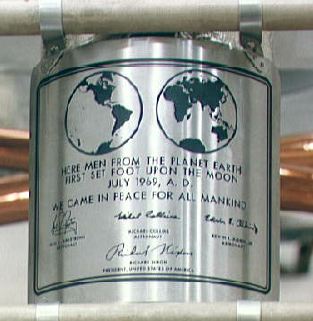
So here is my proposal: We send more men to the moon to confirm whether or not this happened. There have been many artifacts left on the moon, including this plaque.

If man really did land on the moon, the the artifacts, including vehicles, footprints, the flag, and plaques should be there. In this case, we build a museum where the plaque and the first footsteps are. If not, then whoever is there to investigate will go down in history as being the first to walk on the moon.

The museum could become one of the first major tourist destinations on the moon.

Genetically Altering Food Flavors

Most parents have to force their children to eat vegetables. But what if you could make those brussel sprouts taste like ice cream? Then kids (and adults too) would not be able to eat enough of those. From Seed Magazine:
Scientists at HortResearch, a biotechnology company in New Zealand, are isolating the genes that produce flavor in fruit. Their ultimate goal is the development of a technique that will allow large-scale production of compounds identical to the fruit's natural enzymes. "The idea is that the flavor will be more realistic," said Richard Newcomb, a scientist at HortResearch.
That is very good news for wannabe space settlers. In the early years of space settlement, the settlers will not be able to grow the variety of food that they wish. They might have to be forced to eat some nasty veggies because they grow the best in a small closed biosphere. And keep in mind that they won't have seasonings with them to help flavor their food. Perhaps, after the settlement grows to a sufficient size, they will be able to grow anything they want. But in the meantime, it is lettuce, soybeans, and wheat. But genetically altering their flavors can make eating a much more enjoyable experience than otherwise. Besides, after a day (however long the day is wherever you are at) of hard work, wouldn't you want to retire the day to a tasty meal?

Tuesday, August 08, 2006

Digital-Material Convergence #3

In parts 1 and 2, I have talked mainly about using fab labs to create relatively small devices, such as beams, pipes, small solar panels, space ship parts, etc. But how about gigantic structures, such as Space/Lunar Solar Power srrays, or O'Neill settlements? Our fabber seems several orders of magnitude too small for such tasks. This problem is being tackled at this moment.

As it turns out, we can use fab labs to create a manufacturing base that is far beyond anything that exists on Earth today. Enter The RepRap Project. The aim of the project is to create a fab lab that can self-replicate. The simple act of self-replication can make one simple fab lab the size of the family television into the most powerful manufacturing device ever conceived.

How powerful? Let's suppose that the immediately available materials for fabbing are infinite. Let's make another assumption that it takes a week for a fab lab the size of the family television to replicate itself. The week it takes to fabricate the object is a very, very conservative estimate by the way. After 1 week, there would be 2 fab labs. After 2 weeks, there will be a total of 4, and after 3 weeks, a total of 8. Anyone who is familiar with exponential growth knows where this is headed. What about after 2 months (8 weeks)? After 2 months, 256 machines will exist. After 24 weeks, there would be a total of 224, or 16,777,216 machines!! Did this convince to you the power of self-replicating fab labs? I don't think so. How about a year? After 52 weeks, we would have a total of 4,503,599,627,370,496 machines. Clearly, this presents the opportunity to have a manufacturing capacity far beyond what most people could dream.

Of course, the above is a very simplified way of explaining the power of self-replication. There needs to be the raw materials to make this available. The machines will need to be constructed somehow. Because of these constraints, the manufacturing power of these machines will not be subject to a strict square power law.

If you were to build a Lunar base, you might want to send a self-replicating fabber (referred to hereafter as simply "replicator"), a construction machine, a mining machine, a "matter separator", and perhaps a machine that does chemical reactions on the mined material. At first, the main task will be replication. The replicators will mostly replicate themselves, but will also create more construction, mining, and chemical machines. The constructors will put together the parts to build new machines. The mining machines will dig in the regolith and transfer to the chemical machines. The chemical machines will separate the materials in the regolith and will also use chemical reactions to produce new stock material for the replicator. After that, then you can build your base with these machines.

A great resource to check out is Kinematic Self-Replicating Machines. It is an online book, with many studies and papers of replicators. With this sort of technology, it may be possible that a replicator will become the most powerful tool for the settlement of the oceans and of space. With exponential fabbing and replication, the tools of production will become mere appendages of information production. With this, information age fabbing will be much more powerful than industrial age manufacturing. We will be able to embark on construction projects far vaster than anything accomplished or attempted in history to this point. Want to build a shield to block sunlight from reaching Venus in an attempt to terraform it? Replicators will make this possible, and perhaps even rather easy.

Monday, August 07, 2006

Digital-Material Convergence #2

It's not hard to imagine why fab labs will become critical space infrastructure. Ennex writes about using fab labs in space.
When the European settlers came to America, they brought their hammers, axes, saws, and barrels of nails. With these tools and materials they built cabins, barns, and forts. They did not, however, bring wood, the most important construction material they would need, because they knew they would find plenty of timber at their new home site. In fact, in many cases they had to get to work cutting down trees not only to provide lumber for construction but also to provide clear land to plant crops.

When we go to the Moon, Mars, and the Asteroids, we know we will not find any trees or wood. But we will find plenty of other construction and industrial materials, such as iron, aluminum, and magnesium, from which we can build shelters, factories, and machinery. The presence of these materials could save us the expense of launching steel beams and aluminum habitat shells, except for one major problem. What will stand as the modern analog of the settlers’ hammers, axes, and saws? What tools can we take with us to turn celestial rocks and dust into walls and girders?

If you are a space enthusiast, then you have probably heard of In-Situ Resource Utilization (ISRU), in which we build our space infrastructure using the materials in space. For instance, the Lunar base/settlement should be built using Lunar, rather than Earth-based materials to drastically cut costs and the amount of energy to accomplish the task. Using fabbers will make this easier still. Using ready made fabber designs, Lunar regolith can be turned into beams, bricks, walls, wrenches, construction machines, etc. The fabbers will also be useful for repairs. Let's assume that a micrometeroid strikes a solar panel while transiting in interplanetary space. Provided you have raw materials on board, you could build another solar panel. Or, if a pipe has a major design flaw while in transit, you, and perhaps the community of engineers on Earth could analyze the design and fix the flaw. The new pipe design is then uploaded onto the server, where it can be printed on the ship. For it to function properly, then the space ship and the lunar base (and pretty much everything else) must be constructed like a LEGO model. This modularity is very important in a information economy. So if one part malfunctions, it will be easy to replace that one part.

But how would such an economy become started in the first place? Terry Hancock of Anansi Spaceworks has written a 7 part series in the Free Software Magazine on the Free Matter Economy. As a bonus, the series deals with issues centered on space development and settlement.

Digital-Material Convergence #1

The books The Long Tail and The Wealth of Networks have recently been released. Both books are about production in the Information Age. Both books focus mainly on information content such as text, audio, video, and games. Yet, these books are incomplete IMO. The reason is that they do not talk much (if at all) about how this will effect material production. The usage of the new information economy to produce physical objects is not something that is far into the future (although it seems so), but something that is happening today with fab labs, and for more than 15 years with rapid-prototyping. In fact, personal fabrication is where the personal computer revolution was in 1975. If Moore's Law applies to fab labs, then nanotech fabbers will become widespread home appliances by the 2030s, and able to manufacture pretty much anything. There are a few articles and blog entries about these machines.
If you had the necessary raw materials, then you could construct anything that you wanted. With this kind of technology, there can be widespread material abundance among humans. And with extraterrestrial mining and recycling, the amount of raw materials is practically infinite.

Today, we can begin living the fab future. Even though it is not yet available in our homes, we can still use the technology. eMachineshop is a new company that makes this technology available to anyone who has a computer. You download the CAD software, design your product using it, send in the design file, and in about a couple of weeks, the product will be shipped to you. It's sister company Rapid PCB can be used to product circuit boards. This is an engineer's paradise. I'm currently in college to be an engineer, and I cannot wait to produce my first product using fabrication technology. Kevin Carson of the Mutualist Blog has two entries on this.
You could use the fabbing ability of eMachineshop to build you own store with self-designed products. Or, you could use a Freshmeat or Sourceforge for fab designs. Using it, you could design your own product, use someone else's design, or improve upon the design of someone else, just like when developing and using open source software.

Wednesday, July 19, 2006

Bigelow Space Station

Just in the past week, Bigelow made history when it launched a 33% model of their inflatable space station into orbit. The station successfully inflated, and the deployment of solar arrays was also successful. Space enthusiasts and activists often talk of turning "swords into plowshares," and this is a perfect example of it. And old Soviet ICBM had been converted to the space rocket that send the space station to orbit. Perhaps, this should be done much more. The company plans on launching new modules in the near future.
They plan to launch their next experimental module late this year, and will probably be launching them at a rate of at least two a year for the next four or five years. Once Elon Musk’s SpaceX has its Falcon launch vehicle in operation they hope to use that, as well as the Dnepr, to send ever more sophisticated and reliable systems into obit until sometime in the middle of the next decade they will be able to begin work on a habitable structure that can actually be called a real space hotel.
I am very excited about space tourism, and think that it could generate large bucks. However, I am more excited about the research and manufacturing opportunities this could represent. Imagine if universities had a station they could use for research. Perhaps, the Bigelow station bring to fruition the Space Frontier Foundation vision of an Alpha Town.

Thursday, July 13, 2006

Something Richer than Voluntary Extinction

The Space Review posted an essay about people who believe in the voluntary extinction of human beings. In TMP, Savage proposed the opposite. Instead of killing humans, we utilize technology to save our ecosystem, to bring cheap and plentiful food to everyone in the world, to provide high standards of living for everyone, and to expand life throughout the universe. Read the intro here.

Wednesday, July 12, 2006

The Open Source Revolution

The mission of the LUF is not just the settlement of oceans/space and saving the Earth. In the Foundation chapter of TMP, it is made clear that we are working on the total reordering of society to make sure that each person experiences a very high standard of living...one that exceeds that of the upper classes in the United States today. Savage envisioned new political and economic systems. Many of the blog entries on here will speak of new political and economic ideas.

We are in the midst of a true revolutionary era, a true paradigm shift in the way we create, produce, manage, store, distribute, configure, and consume information and objects. The new Open Source Paradigm represents a profound change just as revolutionary as the birth of mass production, and the economic changes that led to the writing of The Wealth of Nations in 1776. When most people think of Open Source, they think of Linux, Apache, GCC. In short, they think of software applications. But it won't be a true revolution if it remains a mainly software phenomenon.

As a result, people are moving beyond software, and into other fields such as medicine, media, scientific research, engineering, etc. In the November 2003 issue of Wired Magazine, an article was published about the application of the Open Source paradigm to other fields.
Open source has spread to other disciplines, from the hard sciences to the liberal arts. Biologists have embraced open source methods in genomics and informatics, building massive databases to genetically sequence E. coli, yeast, and other workhorses of lab research. NASA has adopted open source principles as part of its Mars mission, calling on volunteer "clickworkers" to identify millions of craters and help draw a map of the Red Planet. There is open source publishing: With Bruce Perens, who helped define open source software in the '90s, Prentice Hall is publishing a series of computer books open to any use, modification, or redistribution, with readers' improvements considered for succeeding editions. There are library efforts like Project Gutenberg, which has already digitized more than 6,000 books, with hundreds of volunteers typing in, page by page, classics from Shakespeare to Stendhal; at the same time, a related project, Distributed Proofreading, deploys legions of copy editors to make sure the Gutenberg texts are correct. There are open source projects in law and religion. There's even an open source cookbook.
As that Wired article states, "open source is doing for mass innovation what the assembly line did for mass production. Get ready for the era when collaboration replaces the corporation." One company, Gerlach Space Systems (anyone knows if it is still active as of July 2006?), is planning on building an open source component to the drive to develop and settle space. This blog entry, as well as the PDF and PPT downloads in it, is very nice in explaining why open source is good.
I want to suggest that open source can present us with a third way between government-sponsored space programs and efforts by large corporate organizations. It can give smaller organizations and private efforts the tools to rapidly move development forward.
That is not to say that private enterprise and governmental organizations are bad, and that we should totally abandon them. In fact, I believe that private enterprise and government institutions will still be necessary, but that adding an open source component will greatly aid in the development of the space frontier. How do we define "open source"?

Now, the definition of open source continues to evolve, but at its core is this notion of commons-based method of peer production (which sounds like a mouth full). Basically, all it means is that you have a collaborative group, a group of peers, working together for a common purpose around a shared body of intellectual property. That body of intellectual property is the commons. There are a number of different definitions: the notion that it is a form of decentralized production in which an information commons is collaboratively built, maintained and evolved. The commons forms the primary, but not necessarily exclusive, basis of value from which individuals and firms can draw and to which they can contribute.

Over time, open source has evolved to encompass more. A broader definition developed by Eric Raymond who is one of the fathers of the open source movement describes it as a process of systematically harnessing open development and decentralized peer review to lower costs and improve software quality. This can more broadly be applied to improve product or service quality in general.

And a very broad definition developed by Larry Augustin, one of the most successful Linux entrepreneurs, is that open source is a way of doing business in which a firm enlists its customers in a constant feedback loop designed to improve its product. I would suggest that it is not only customers, but all of the stakeholders in the activity, including customers and partners who are all enlisted in this constant feedback loop.
And what makes "open source" so effective?
It enables experimentation that doesn’t otherwise take place. It provides a vast resource of inexpensive capabilities to try new ideas. It encourages experimentation because of the parallel paths that can be taken and the parallel approaches. It encourages innovation. It has a very different set of economics from traditional corporate processes. It encourages individuals and groups to explore things that would otherwise not be explored. It actually encourages an extraordinary degree of competition. Because you don’t have the barriers of intellectual property rights and secrecy to help ensure that competition is held in check. There is actually a tremendous level of competition that does not otherwise take place. It is disruptive. It enables the development and exploitation of disruptive approaches and technologies. It is inherently disruptive of traditional development and production processes. It creates real options, by maximizing the range of options available to developers and end users. It creates option value. It ensures responsiveness, because if you have a problem it encourages you to go out and fix it. It provides mechanisms for feedback and for adaptation and changes that do not exist in traditional commercial operations. Quality: by having so many people focused on identifying and fixing problems and by having process transparency, you can achieve levels of quality that are otherwise impossible to achieve. And then, this value of democratization provides inexpensive resources and structures for experimentation. Democratization is a value that is inherent in itself but it is also a value that creates additional value for the larger group of contributors and society that cannot otherwise be obtained.

There are those who argue that open source as a new mode of production is underpinning the birth of a new kind of economy. If you think about the challenges that we face as we struggle with the baggage of the industrial economy, traditional, integrated business models in many industries are breaking down because of their inability to adequately meet the needs of individuals, their inability to economically scale their customized processes, and their inability to capture more than incremental gains from the adoption of technology. An open source economy may be the ultimate response to many of the limitations of traditional industrial business models, as growing numbers of individuals and organizations seek to leverage the power of modern computing and telecommunications technologies to find new approaches to producing innovative products and services.
People are often amazed that Linux, Apache, and other very good software products are open source. If you have used both Windows and Linux, then you might've been surprised at how stable Linux is and at how good many of the Linux software products are. The Windows XP operating system cost millions upon millions of dollars to develop. Yet, with all of the resources spent developing the OS, it is still ridden with bugs and security holes. And on top of that, it will set you back about a few hundred dollars. Other software, such as MS Office, and Adobe Photoshop operate in the same way. The odd thing is that a very, very few of software products actually turn up a profit. But you can get very decent open source alternatives to nearly every proprietary software product for free, or (at worst) for a very low cost. It didn't cost much money to develop Linux, OpenOffice, nor The GIMP. And these products are all free to download, share, use, and to improve on. Perhaps, one of the greatest myths is that people will refuse to do anything productive if they don't get paid for it. Many people won't. But the success of open source projects, as well as most people who do anything that might be considered creative, are willing to do so. After all, many people do things like this simply because is it something they like to do, a process that Oekonux founder Stefen Merten calls "self unfolding." But what does this have to do with, say, settling space?
By building an open source space program, we can build around the blockages that have limited private space development to date. It leverages advanced telecommunications and computing capabilities to bring together hundreds and even thousands of expert contributors on a global scale. It opens design processes and intellectual property for use and enhancement by all of the participants. It enables innovation and widespread participation in private space development efforts. Ideally, it gains the participation of the major government and corporate organizations in the space sector, such as NASA, ESA, Boeing and so forth.
Picture that on the Internet, you had thousands of engineers around the world designing the space craft, the space station, or the Lunar base. Because this process would be "self-unfolding", many who are enthusiastic about space and engineering would do engineering work on the project. This would also facilitate the development of state-of-the-art software to aid in the design and virtual testing of space craft designs (such as Open SESSAME). With a developed database of free space craft designs, there would always be cutting edge technology that companies, governments, or other types of organizations (or even individuals) can choose from in developing their space ship. Or imagine if NASA open sourced the Space Shuttle. If this happened, then many people around the world could design improvements to the shuttle, providing a vehicle built using 1970s technology with state of the art technlogy, and perhaps even redesigning the Shuttle to leave the External Tank in orbit to further help in the development of space.

Saturday, July 08, 2006

Propellant from Lunar Soil

I think that using Lunar ice for rocket propellant is a serious waste of resources. All ice should be used for life support purposes, IMO (and in the opinions of many others). There are other materials on the Lunar surface that should be sufficient for escaping from the Luna. The Solar Empire Blog has already written a blog entry based upon this article.
It is well known how to get LOX into a rocket engine combustion chamber under pressure, but how would it be possible to get any of these fuels into a combustion chamber? Phosphorus and sulfur could actually be the easiest as they both melt and could be fed as liquids. Phosphorus melts at around 111o F. It has the advantage of auto-igniting with oxygen. Sulfur melts at 239o F, but if heated above 482o F, it will also auto-ignite with oxygen.

For aluminum and magnesium fuels, they would be in the form of a powder as their melting temperatures are too high. They could be injected into the combustion chamber with an inert carrier gas. We have built a rocket engine using carbon dioxide and magnesium powder for use on Mars that blows the magnesium powder via nitrogen gas into the engine's combustion chamber. This approach could also be used with magnesium or aluminum powder for a LOX-aluminum or LOX-magnesium rocket engine. An additional option available with aluminum is to suspend the aluminum powder in gelled LOX to form a monopropellant. This option is not available for magnesium as it is shock sensitive in LOX and will detonate.
This will not develop the thrust equal to an oxygen/hydrogen engine, but given the low gravity of Luna, this should be sufficient for blasting from that body.

Friday, July 07, 2006

Nanotube Water Desalination

Our planet faces a severe water shortage problem. There is the prospect of water wars in many places in the world. But there is a new technology using nanotubes that could reduce the cost of water desalination to one fourth of what it is now.
The new [nanotube-based]membranes, developed by researchers at Lawrence Livermore National Laboratory (LLNL), could reduce the cost of desalination by 75 percent, compared to reverse osmosis methods used today, the researchers say. The membranes, which sort molecules by size and with electrostatic forces, could also separate various gases, perhaps leading to economical ways to capture carbon dioxide emitted from power plants, to prevent it from entering the atmosphere.


Wednesday, July 05, 2006

Photos: Airships on the fly

Photos: Airships on the fly | CNET News.com

This photo gallery of various airships cover the broad spectrum of uses of airships as they make their comeback. Blimps and zepplins are being used for everything from space telescopes to personal transportation. There are concepts for a luxury air cruise as well as commercial and military telecommunications. Enjoy.

Geodesic domes

Geodesic domes: 'Doing more with less' | CNET News.com

I thought that this was an interesting article about geodesic domes. It begins with a CNET News.com writer's personal experience with geodesic domes and a discussion about Pacific Domes, one of the leading dome kit supliers in the U.S. In the comments section, Timberline Geodesics is listed as an alternative supplier.

I mention geodesic domes, because I was wondering if any thought had been put into using them as a basis for ocean homesteading or colonization? I imagine a spherical house boat surrounded by a hexagonal deck would be quite a site. Also, multiple decks could be linked into a growing community of sea domes.

The material and energy efficiency of these domes could also be enhanced by some combination solar power, wind turbine, and wave energy.

Sunday, July 02, 2006

Kuiper Belt Resources

For decades, it has been believed that the original Asteroid Belt represented the ultimate resource base in the Solar System. In TMP, it was stated in the Solaria chapter that the original Asteroid Belt contains enough resources to sustain 7500 trillion (7.5 quadrillion) people. The book Mining The Sky states that that Asteroid Belt has enough iron (and other resources) to meet the needs of 10 quadrillion people, and that the Greek and Trojan asteroids (which lie 60 degrees ahead and behind Jupiter in its orbit). may contain 4 times as many asteroids as the main belt. These asteroids "appear to be supercarbonaceous" which means more life-sustaining volatiles such as carbon, nitrogen, oxygen, and nitrogen. That resource should then be able to sustain more than 40 quadrillion people.

But these books are now obsolete because of the newly discovered Kuiper Belt. As it turned out, the Solar System does not have one asteroid belt, but two. The second one begins just beyond the orbit of Neptune. It is composed mainly of iceteroids (comets). Neptune's Triton is a captured Kuiper Belt object, and Pluto and Charon are also Kuiper Belt object. Clearly, this belt has objects far larger than those in the main belt. Many are nearly the size of Pluto such as Sedna and Quaoar. 2003 UB313 is even larger than Pluto.

Just the fact that the circumference of the Kuiper Belt far exceeds that of the main belt should give you a clue that the Kuiper Belt might have much more resources than the main belt. But how much? It is estimated that the asteroid belt contains 4% of the mass of the Moon. The Kuiper Belt has a total mass estimated to be between 0.5 and 30 times the mass of Earth. That means that the Kuiper Belt has between 1,000 and 60,000 times the mass of the asteroid belt. While the asteroid belt can sustain a human population numbering in the quadrillions, the Kuiper Belt will have a human population in the quintillions. Also, keep in mind that this far out, most of the mass is volatiles anyway. So that might mean that the Kuiper Belt can have a population numbering in the sextillions.

Thursday, June 29, 2006

Tech Entrepreneurs Take On Space Frontier

How many of you are (or have been) fans of the Doom and Quake series? Or how many like to shop on Amazon.com, and how many have used Paypal? All of these products are very popular tech products. Doom and Quake practically defined (and redefined) the 3D First Person Shooter (FPS) genre. Amazon.com is the most popular online store for purchasing media (books, music, movies, software, etc.). Paypal is one of the most popular systems used for paying online. The people behind these are leaders in the tech industry. John Carmack is the legendary programmer of the Doom and Quake series. Elon Musk is the head of Paypal. Jeff Bezos is the founder of Amazon.com. Paul Allen, who financed the X-Prize winning SpaceShipOne is co-founder of Microsoft with Bill Gates. All of these individuals have made millions (and billions?) in the software industry.

Most people have wondered what would happen if these rich "gazillionaires" had decided to spend some or much of their fortune on developing the space frontier. What if they funded the upcoming rocket companies? What if they decided to build their own rockets into space? This is exactly what those individuals mentioned above are trying to accomplish. Jeff Bezos is the founder of Blue Origin, and has just unveiled his plans to build a space center and to build sub-orbital rockets. Elon Musk has founded SpaceX, and plans on building rockets to space. The Armadillo Aerospace founder John Carmack is the "fearless leader" who "will lead us to space."

NPR has recently done a nice story on these tech-turned-space entrepreneurs. With their deep pockets, the space frontier may finally be opened to normal people. Godspeed to all for their efforts.